This is my attempt at beating the buyers-remorse before it sets in.
Nikon D500
Price new: $1789.00, Body only Price refurbished or used: ~$1050, Body only Price I found: $750 + $30 membership + $27 shipping = $807, for Body, Arca L-bracket, Battery Grip, 8 batteries and 2 chargers.
If I add a fast SD card for $90 or a CF Express Type-B for $200 I would still come in under the price of a refurbished body.
I am coming from a Nikon D3200 (24 MP Expeed 3) and Nikon D3400 (24 MP Expeed 4). This D500 is also a DX APS-C Cropped sensor, at 21 MP. Similar number of pixels to the prior two cameras, but a newer sensor and a much more powerful processor.
But even at this price, why drop almost $1K on a slightly lower resolution camera body?
Here is the list of direct improvements from the entry-level bodies that I am looking forward to:
- 155 AF points, vs. 11 for D3400 or 9 for D3200.
- 10 fps burst, vs. 5 fps burst.
- Much higher ISO range.
- Better performance at high ISO. (16k still looks fine with post-processing)
- Better EV for AF acquisition.
- Dual storage for photo backup in-camera.
- In-body AF motor to support old lenses.
- More function buttons for rapid setting changes.
- Illuminated buttons.
- Dedicated backlit LCD on top of body.
- Higher coverage viewfinder.
- Higher resolution LCD for image review on-camera.
- Touch Support for LCD/pinch-to-zoom.
- Tilting LCD.
There're other features that this body has that I don't even have a frame of reference for, such as...
AF Calibration tests out a lens, and then compares what it thinks is in-focus to what is actually in-focus. It then saves that calibration for the lens specifically, so the next time you use it, it can adjust on the fly to give better focus results.
A plethora of new AF modes are available, such as 3D, phase detection, group, dynamic and others.
Auto ISO, with ISO max settings to keep it from getting noisier than you want. Both the D3200 and D3400 do support auto ISO, but only in certain modes, and without options for capping ISO.
Dedicated iso adjust button (previously I have dedicated a programmable fn button just for this), a re-assignable record button, and two re-assignable Fn buttons.
A total of three new-to-me programmable buttons put a lot of settings in muscle-memory territory.
The D500 is weather-sealed, meaning that I can use it with my Tamron 100-400 DC VI USD (which is my favorite birding lens, and also is weather sealed) in the rain without worrying about the camera or lens being damaged.
The in-body focus motor opens up new options for older lenses as well. Unlike the D3200, which only supports lenses with a built-in motor, but not AF-P lenses, or the D3400 which supports AF-P lenses, but not certain older lenses, the D500 should support ALL of my lenses. AF, AF-I, AF-S, AF-P. Anything that fits an f-mount should work with this camera.
From my research the problem with the D3400 seems to be that Nikon dropped a few pins from the f-mount on that camera. As such, even if you use an older non-compatible lens in Manual Focus, it won't let you take a photo, because the body can't communicate with the lens at all for focus, metering, aperture, etc.
It really is difficult to describe just how much of an irritation it has been having overlapping lens compatibilities thus far. The D3200 worked with some old lenses, so long as they have the right motor. But it couldn't use the much lighter AF-P kit lenses for a lightweight travel kit. The D3400 worked with almost no old lenses, but did work with AF-P and my Tamron. That body is a few years newer, and so had nice features that I wanted to use, but I could only use them with some of my kit. I don't want to carry two camera bodies around, and have two sets of everything (arca plates, capture clips, etc) just to cover the full spectrum of the lenses that I want to carry. The D500 should now make it so that there are no limits. AND because it's not full frame, I don't even lose access to the DX kit lenses that I've had for eons.
Update
I now have the camera in-hand!
Initial thoughts:
- It is very fast. By far the quickest bursts I have ever experienced, and certainly fast for a DSLR.
- The body is heavier than I was expecting, but not unreasonable.
- It is certainly bigger. I never noticed it before, but the 3x00 series only gives a three-finger grip, with your pinkie hanging off the bottom. The D500 lets you get a full grip on it.
- The viewfinder feels massive. The amount of information that is able to fit in there, and the field of view are both impressive.
- There are way more buttons that I will need to commit to memory than I was expecting.
- There is a "virtual horizon" that you can use in the viewfinder that tells you whether you are shooting level or not. I don't know how important it really is, but its cool from a technical standpoint if nothing else.
- I thought the etching in the viewfinder was in the glass, but NOPE. You can change "reticles" with the push of a button and get different illuminated markings that still work when the camera is off. I have ZERO idea how they do that.
- You can burst up to 30 photos using only the camera's internal buffer (3-seconds of burst) with a UHS-I class 10 card.
- The poor UHS-I card writes for a full minute after attempting this. Thankfully powering off the camera does not impede writing from buffer to storage.
- If you run out of battery during the write from buffer to SD card, you will lose your images.
- Not sure if this will work well with my Peak Design Capture Clip for extended periods of time. Really its not much heavier or larger, but it feels like a full proper camera.
- There are so many buttons.
- I feel like moving from a D3x00 to the D500 is about the same jump as moving from a smartphone camera to a DSLR, but again.
- There is a preview button that shows you a preview of your depth of field, based on your aperture settings, in-viewfinder before taking the image. Again, super cool and technically impressive.
- There's a dedicated button for changing your image quality on the fly. Not sure what this is for. Definitely not something I am going to use much. All RAW, all day.
- You can set which storage slot has priority, but with only one card, it just uses that one card for storage.
- You can set which batteries have priority when using the battery grip. This is important because the battery grip stops you from removing the in-body battery.
- Battery grip can run from AA batteries only. That would be very helpful in a pinch. Although I do also have a USB-C charger for these batteries.
- THERE ARE SO MANY BUTTONS!
- The AF/M selector is both a toggle selector, and a button. Who knew?
- The joystick and back selector can both control your focus point, but only if you do not have your back selector dial set to
L. This locks your focus point. - There is the normal "command dial" wheel under your right thumb that I am used to, but I spent a long time without knowing that there is also a "sub-command dial" under your right index finger. Had to read the manual to find that one. That is not something I have ever experienced on a camera before.
- The buttons are illuminated, which makes for pleasant and simple low-light navigation. Not sure why they didn't illuminate
fn2though. It's inline with the other glowing buttons on the left side. You can easily guess where it is from context, so its not a big deal. - This camera makes lenses that I thought were large and heavy look far more proportional.
- The seller shipped me an L-bracket that I was on the fence about using, but I have now seen an idea where someone used a rifle sling and QD adaptor for a nicely customizable camera sling and now I really want to try it.
Update 2, First Outing
For my first outing with the camera, and first real photo day, I selected the Nikkor 300mm f2.8 IF-ED Prime This is a lens from the late 90s as my best guess, with a loud screw-drive AF system. This lens is part of why I wanted to get a pro-level body in the first place, since my entry-level 3x00 systems do not have focus motors in-body.
One thing that I love much more than I expected, and I imagine it comes from the in-body focus motor, is that this camera is able to drive autofocus on nearly all my lenses (I haven't tested every lens on this body yet) without moving the focus ring at all. This means that I can use the entire length of the lens body as a support point, rather than gingerly avoiding any surface area that would interfere with the focus ring. This is especially nice for the 300mm prime, as it weighs several pounds.
Even though the 300mm has less "reach" than my current favorite birding lens, a Tamron 100-400, it still was enough to get all of the shots I was hoping for. In cases where I did not have enough reach, I don't think the extra zoom would have gotten the shot anyway.
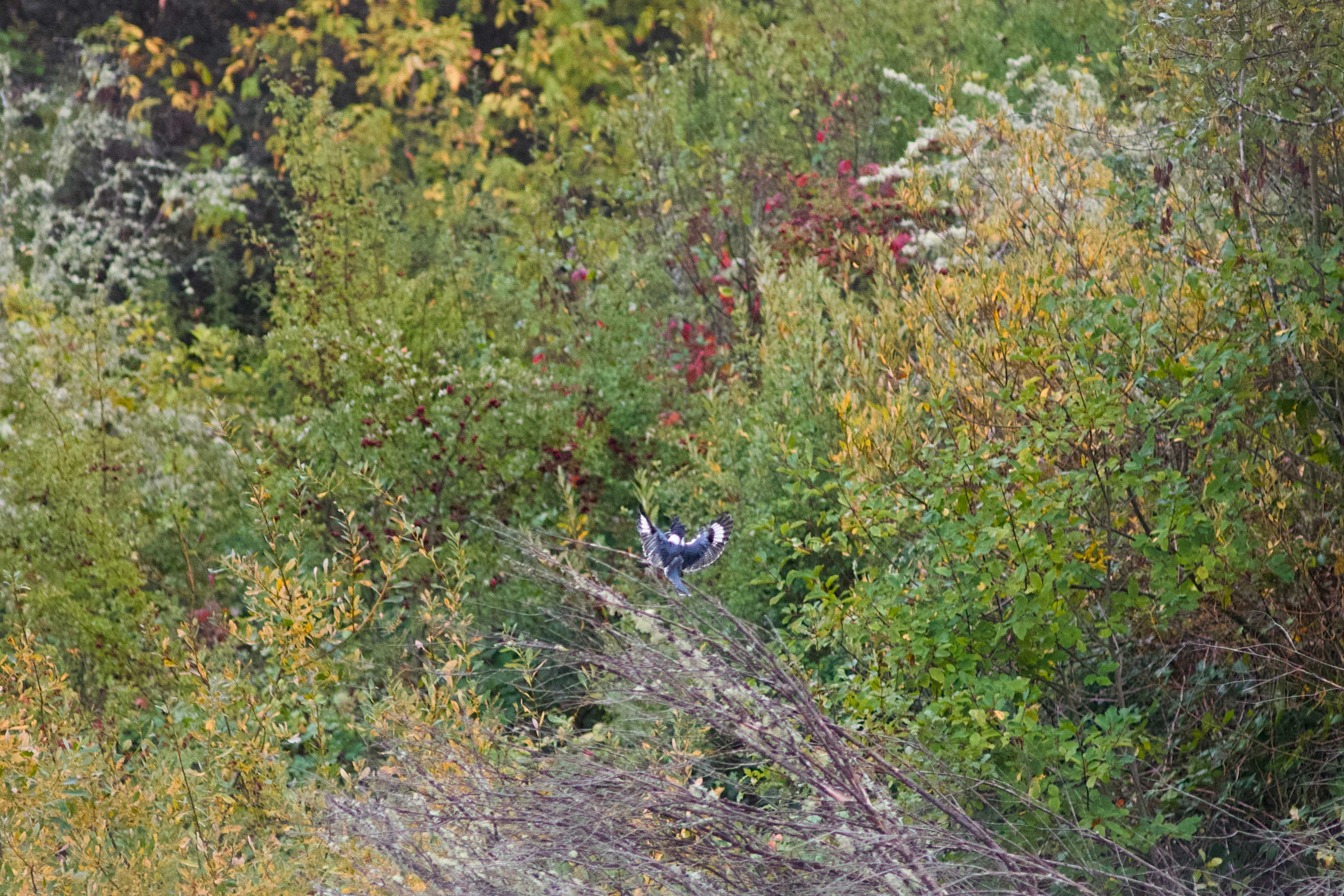
Kingfishers are elusive, but I will get a good close up of one some day. I think it will take planning and forethought, rather than hoping for a good photo opportunity on a family walk.
 The Tamron has a rapid AF system, with some smart features like distance limited AF and a CPU that can rapidly calculate the changes that need to be made to get focus on the fly without hunting.
The 300mm Nikkor has none of those things.
The major benefit to the 300mm prime over the Tamron 100-400 is the f2.8 aperture. This puts it firmly in the "fast" telephoto category, and is a marked improvement over the f6.3 on the Tamron at 400mm. This meant that on my bird walk, I could set the D500 to shutter priority, at 1/2000th, cap Auto-ISO at 16000, and let it rip.
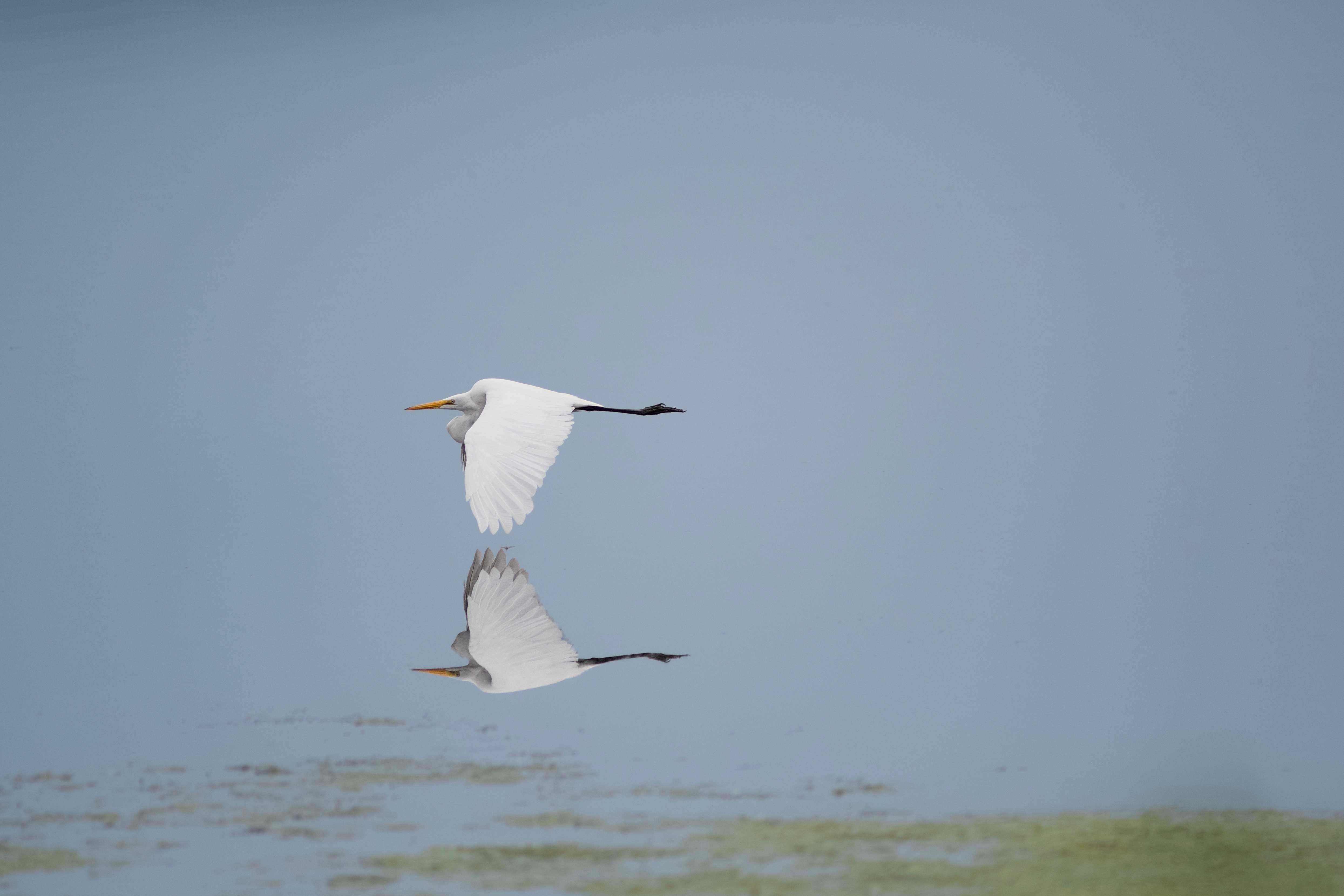 Even on a socked-in foggy morning, I was able to hit fast shutter speeds with rapid 10 fps bursts to capture birds in flight.

The group AF on the D500 is excellent, and is what I used most consistently. I did program single-point focus to a click of the joystick, but I did not use it unless I was trying to focus a bird hiding among branches.
I don't think I ended up keeping any of my "bird in branches" shots this outing. I just didn't end up with compositions I liked.
Wrap it up
To avoid straying too far towards a lens review, and completely out of camera review territory, I'll wrap things up here.
At the price that I paid for this body, I think it was a good purchase. If I were shooting professionally I could even call it an ✨investment ✨, but I'm not, so I won't. I have a large enough collection of f-mount lenses, some with immense sentimental value (inherited from my grandfather,) that it made no sense to switch to a mirrorless body. The improvements in a professional body are staggering, even if it doesn't have some of the nice new mirrorless features (IBIS, Pre-Capture, etc.).
I am happy with this purchase, and I'll be using this camera likely as long as I use Nikon DSLRs.