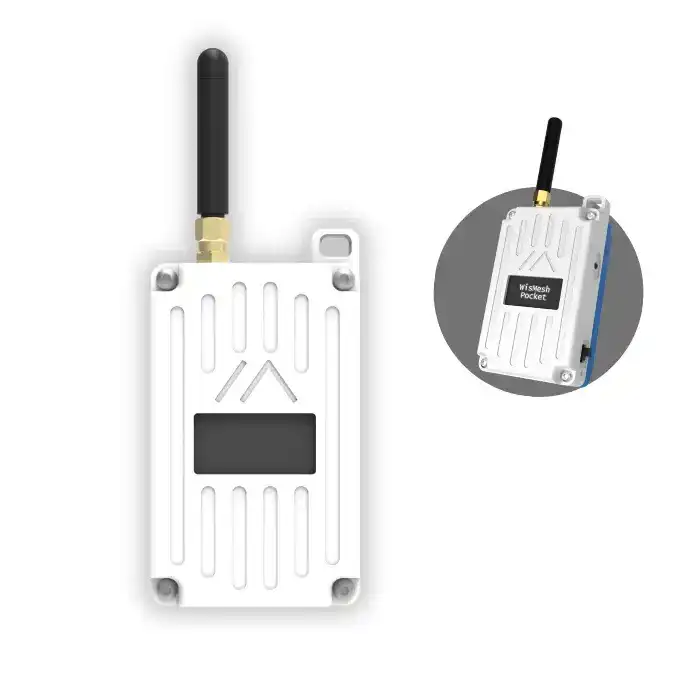
This was my first ever Meshtastic node. As I write this, its still the only node I own. This is the Rak Wireless WisMesh Pocket V1. It functions as a text-only LoRa radio, in the ~915 MHz band (in the U.S.).
The real functionality is in the firmware. Meshtastic, and other projects such as MeshCore, allow you to connect a radio to a meshed network of other radios on the same band. This small radio, using mesh networking, can communicate hundreds of miles, all without cellular or WiFi.
What Went Wrong
When I got my first Meshtastic node, I was overjoyed! The possibilities seemed limitless, and I was eager to start connecting with other people adopting this awesome new tech. Looking at the Meshtastic node map, there were not many nodes in my area, but there were more nodes in the Portland area. I decided to try next time I was there, to see if my radio could connect to the mesh. While in Portland I received some messages. My radio worked! But I was unable to respond to anyone. My node kept hitting failures, and could not reliably send to the network. After this experience repeated, no matter how many nodes I thought were nearby, I gave up, and tossed my node in a drawer.
It has been two years since then, and three important things have changed.
- I am no longer using the default Long Fast public channel.
- The Meshtastic firmware has improved drastically.
- Robust local communities like Mesh Oregon are pushing Meshtastic adoption and coverage forward.
Why Its Working Now
Joining a node to the Mesh Oregon network is simple. Use the firmware flasher on their site to have it configure the node for you, or download and flash the firmware to your device over USB.
That's it. That's the whole process. Give your node some time, and watch it discover other nodes!
Realistically, there are still plenty of dead-zones, or areas without good coverage, but if you are on the West-coast, the coverage is pretty impressive. But the members of Mesh Oregon are working on expanding the network constantly.
There're even more-localized groups for Willamette Valley, Central Oregon, Roseburg, and Wild Rivers Coast.
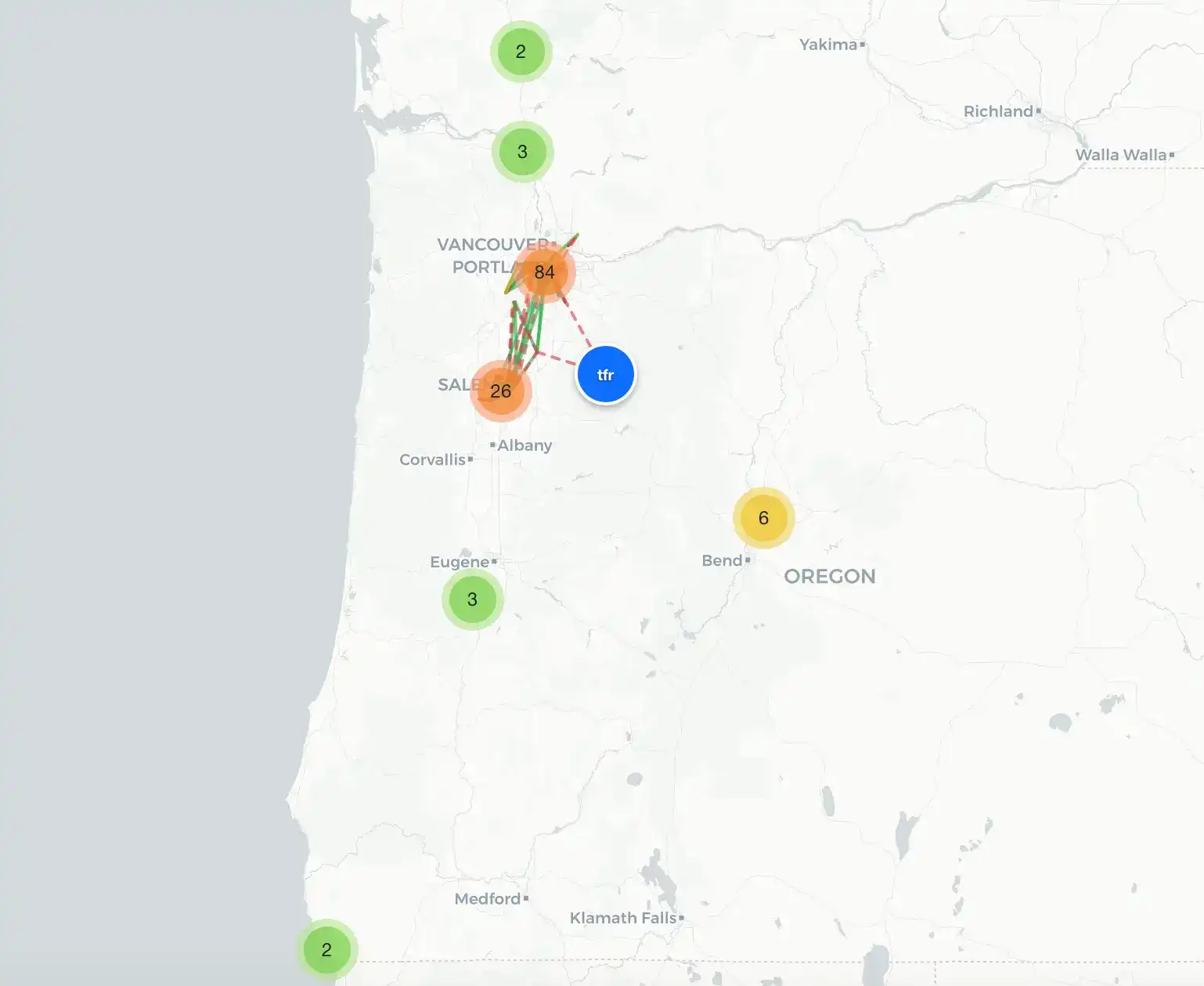
It doesn't look like much, but the routers on this map let you communicate for hundreds of miles reliably.
How is Mesh Oregon Different from Meshtastic Long Fast?
It uses its own frequency, and custom spread and bandwidth settings to improve throughput, and minimize congestion.
It also uses a carefully planned network architecture to avoid congestion, and improve coverage over the standard public Long Fast channel.
But MeshCore is Better
In some ways, yeah! You're right!
However...
Mesh Oregon takes the design choices of Mesh Core (dedicated stationary routers, and "companion" nodes), and applies it to Meshtastic through careful planning and community coordination. Routers are placed in high elevation locations, with high power outputs and nice antennas. Then, portable nodes are set with the Client, or preferrably Client Mute roles.
Client Mute means the node is able to send and receive messages, but that its not allowed to pass messages along the mesh on behalf of other nodes. Its like the node is opting out, and saying "Hey I don't have a consistent signal, don't pass to me!" which is a great option for vehicle nodes, EDC trackers, etc!
Stationary nodes in high elevations get the Router or Router-Late role. This optimizes the node for passing along messages to other nodes, and gets the benefit of the new Zero-cost Hops feature.
Zero-cost Hops means that for any Meshtastic "client", it will not count nodes that it has in its favorites list against the number-of-hops budget. In practice, this means that for a node with good routers in its favorites list, it can jump far beyond the default 3 hops, so long as each router can see its neighbor and has the others in its own favorites list.
It can use a chain of routers like a backbone, only leaving the chain to reach its final destination. This is the MeshCore-like thinking that makes Mesh Oregon so robust and performant!
Firmware updates, additional features, and careful community planning have created a useful, robust, offline communication network using Meshtastic.
Conclusion and Next Steps
If you have an unused Meshtastic node near I-5 in Oregon, try Mesh Oregon and you'll likely be surprised by the improvements in local mesh coverage, and in the improvements to the Meshtastic firmware. Just be sure to update your nodes to the latest firmware before joining!
My next steps will be to get some dedicated Client Base nodes that will be stationary in my most frequently visited locations. This will give me something to catch messages, and hand them off to my portable node, rather than relying on that single node to handle everything. It should also help to improve message sending and receiving when hopping from a node in a backpack, to a stationary node with better visibility, and then onto the network from there. I am thinking some SeeedStudio Wio L1's will be interesting to play with.
Who knows, I may also try flashing MeshCore to one as another experiment. Stay tuned.